Why Evidence-Based Medicine Matters in Daily Practice
Modern clinical practice is shaped by rapidly evolving medical knowledge. New studies are published every day, guidelines are frequently updated, and clinical decisions are expected to reflect the best available evidence. In this context, evidence-based medicine (EBM) is not an abstract academic concept—it is a practical necessity.
This article explains why evidence-based medicine matters in daily clinical practice and how it supports better decision-making for both clinicians and patients.
What Is Evidence-Based Medicine?
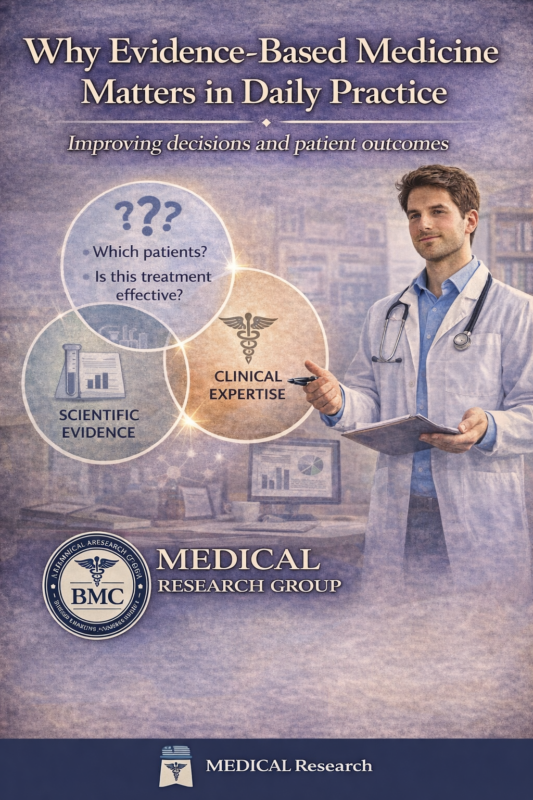
Evidence-based medicine is commonly defined as the integration of:
-
The best available scientific evidence
-
Clinical expertise
-
Patient values and circumstances
EBM does not replace clinical judgment. Instead, it strengthens it by ensuring that decisions are informed by reliable data rather than habit, anecdote, or outdated information.
Why Clinical Experience Alone Is Not Enough
Clinical experience is invaluable, but it has limitations. Individual experience can be influenced by:
-
Small sample sizes
-
Cognitive bias
-
Selective memory of outcomes
-
Lack of comparison groups
Without evidence, clinicians may overestimate treatment benefits or underestimate risks. Evidence-based medicine provides a systematic way to evaluate whether observed outcomes are truly effective or simply coincidental.
How Evidence Improves Daily Clinical Decisions
In everyday practice, evidence-based medicine helps clinicians:
-
Choose treatments with proven benefit
-
Avoid ineffective or harmful interventions
-
Interpret guidelines appropriately
-
Adapt recommendations to individual patients
EBM supports more confident decision-making, particularly in complex cases where multiple options exist and outcomes are uncertain.
When Evidence and Guidelines Do Not Fully Apply
One of the most common misconceptions is that evidence-based medicine means following guidelines rigidly. In reality, guidelines are based on population-level data and may not always fit individual patients.
Clinicians must consider:
-
Comorbidities
-
Patient preferences
-
Resource availability
-
Local practice context
Understanding the evidence behind guidelines allows clinicians to adapt recommendations responsibly rather than apply them blindly.
The Role of Research Literacy in Evidence-Based Practice
To practice evidence-based medicine effectively, clinicians need research literacy—the ability to:
-
Read and interpret medical literature
-
Understand study design and bias
-
Evaluate statistical results
-
Recognize the strength and limitations of evidence
Without these skills, evidence becomes difficult to interpret and may be misapplied, even when high-quality studies are available.
Evidence-Based Medicine as a Lifelong Skill
Evidence-based practice is not a one-time achievement. It is a continuous process that evolves with new research and clinical experience. Developing comfort with medical literature and research methods allows clinicians to stay current and provide care that reflects the best available knowledge.
Key Takeaway
Evidence-based medicine enhances—not replaces—clinical judgment. By understanding how evidence is generated and applied, clinicians can make better-informed decisions, improve patient outcomes, and practice medicine with greater confidence and integrity.
