What Is Medical Research? A Clinician’s Perspective
Medical research is often perceived as a separate domain from clinical practice—something conducted by academics, statisticians, or full-time researchers. For many clinicians, research can feel distant, complex, and disconnected from everyday patient care. In reality, medical research is deeply rooted in clinical practice and plays a critical role in improving patient outcomes.
This article introduces medical research from a clinician’s perspective, focusing on its purpose, relevance, and practical value.
Medical Research Begins With Clinical Questions
At its core, medical research starts with questions arising from real clinical experience. These questions often emerge when clinicians notice patterns, inconsistencies, or uncertainties in patient care, such as:
-
Why does a treatment work well for some patients but not others?
-
Why do outcomes in practice differ from those reported in guidelines?
-
Which intervention is truly more effective in a specific population?
Medical research provides a structured approach to transforming these observations into answerable research questions, allowing clinicians to move beyond anecdote and intuition.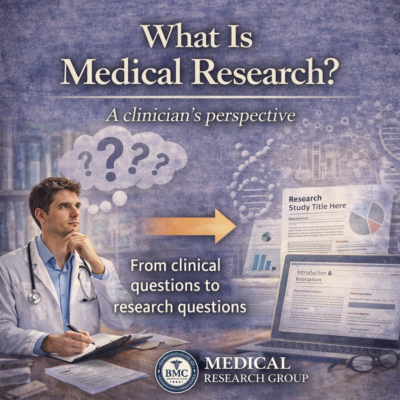
The Role of Medical Research in Evidence-Based Practice
Evidence-based medicine relies on the integration of:
-
Best available scientific evidence
-
Clinical expertise
-
Patient values and context
Medical research generates the evidence that informs clinical guidelines, diagnostic strategies, and therapeutic decisions. Without rigorous research, clinical practice risks relying on outdated information, personal bias, or incomplete data.
For clinicians, understanding how evidence is produced is essential for interpreting and applying it responsibly in daily practice.
Why Medical Research Feels Challenging for Clinicians
Many clinicians find medical research difficult not because of a lack of ability, but because of structural barriers, including:
-
Limited formal training in research methodology
-
Unfamiliarity with statistics and data analysis
-
Time constraints due to clinical workload
-
Difficulty interpreting scientific literature
These challenges can make research seem inaccessible. However, medical research does not require clinicians to become full-time scientists. Instead, it requires foundational literacy in research principles and a practical, step-by-step approach.
Medical Research Is Not Separate From Clinical Practice
Research and clinical care are often viewed as two distinct worlds. In practice, they are closely connected. Clinical experience shapes research questions, and research findings refine clinical decision-making.
Clinicians who engage with medical research are better equipped to:
-
Critically evaluate new evidence
-
Adapt guidelines to individual patients
-
Identify gaps in existing knowledge
-
Contribute meaningfully to improving care standards
Medical research is not an abstract academic exercise—it is an extension of thoughtful clinical practice.
Moving Forward: A Practical Approach to Learning Research
Medical research becomes more approachable when it is taught in a way that is:
-
Clinically relevant
-
Ethically grounded
-
Structured and practical
Developing research skills does not require advanced mathematics or complex theory at the outset. It begins with understanding basic concepts, learning to ask the right questions, and gradually building confidence in interpreting and generating evidence.
This platform was created to support clinicians on that journey—step by step.
